Skip to main content

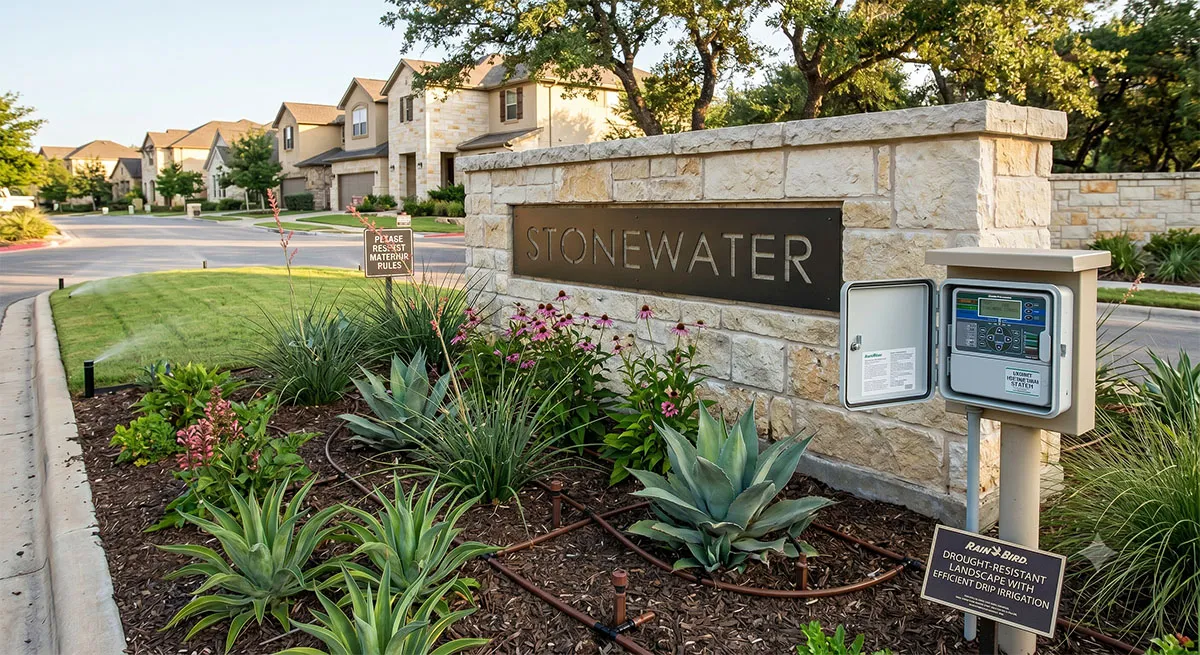
Austin summers turn landscaping into a board issue fast. Turf goes from green to stressed in a few weeks of July heat, irrigation timers get questioned by residents, entries start looking dry, and enforcement decisions get complicated when the whole neighborhood is working within tight watering windows. Add in the fact that Austin water restrictions affect HOA common areas differently than individual residential addresses, and the average board is navigating a set of rules most vendors and homeowners don’t fully understand.
This guide covers what Austin HOA boards need to know before peak heat: the current Austin watering restrictions and how they apply to common areas specifically, what to confirm with your landscape vendor, how to handle enforcement fairly during drought conditions, and how to communicate with residents so complaints don’t pile up faster than the brown spots.
Current Austin Water Restrictions and the HOA Watering Schedule
Austin Water’s Conservation Stage restrictions limit when and how often outdoor watering can happen, and HOA common areas follow a different designated schedule than individual residential addresses. This distinction matters and most boards don’t know it exists until a vendor or resident brings it up mid-summer.
Here’s how the current rules break down under Austin’s Conservation Stage restrictions:
Austin Water Restriction Stages at a Glance
Automatic and manual irrigation systems: 1 designated watering day per week, within the 7 p.m.–10 a.m. window only
Hose-end sprinklers and drip irrigation: Up to 2 designated days per week, same 7 p.m.–10 a.m. window
Hand-held watering and tree bubblers: Allowed any time, any day
HOA common areas: Listed under a separate Austin Water property category (public schools, HOAs, and golf course fairways), so your designated day may differ from nearby residential addresses
Verify your property category and designated watering day at Austin Water’s Find Your Watering Day tool. Restriction stages can change, so check before peak season and again if conditions worsen.
The key operational task for boards is confirming which rules apply to which parts of the community before summer gets started. Before peak heat, verify: which areas are HOA-maintained versus homeowner-maintained, which meters and irrigation controllers serve each HOA zone, which Austin Water property category the community falls under and what the designated watering day is, and whether any parts of the community are served by a MUD or water district with different restriction stages and schedules. If your community is not on Austin Water service, contact your utility provider directly to confirm the current rules. Austin-area MUDs do not always mirror Austin Water’s restrictions.
Vendor Coordination and Water Waste Prevention
HOA boards don’t water lawns; vendors do. Vendor autopilot is where most irrigation compliance problems start, and it’s usually what’s behind both resident complaints and unnecessary water costs by the time the board hears about it.
Before summer, the board or community manager should confirm the following with the landscape and irrigation vendor:
- Are all irrigation controllers programmed for the current Austin watering schedule and the allowed 7 p.m.–10 a.m. window?
- Are rain sensors and freeze sensors functional and actually interrupting cycles when conditions warrant?
- Are broken heads, leaks, overspray, and runoff being logged and repaired on a defined timeline?
- Are zones being run based on actual plant need (trees, turf, and beds have different requirements) rather than a one-size schedule that doesn’t adjust for heat and soil conditions?
- Are trees, slope areas, and entry beds being prioritized? These are the areas that show stress first and draw resident attention fastest.
Water waste is also a compliance issue under Austin rules, not just a cost concern. Austin prohibits water waste at all times, regardless of restriction stage. The most common HOA irrigation issues that create water waste risk: broken or tilted heads spraying pavement instead of landscape, valve leaks creating pooling near curbs or sidewalks, high pressure causing misting that drifts away from the intended area, run times set long enough to generate runoff onto streets, and irrigation running outside the allowed window because a controller was never reprogrammed after a schedule change. These problems are often visible from the street, which means residents notice them before the board does. A vendor check-in at the start of summer, with a follow-up in late July when heat peaks, catches most of them before they generate complaint emails.
Enforcement, Brown Grass, and HB 517
During watering restrictions, boards need to separate true neglect from drought stress. They’re not the same thing, and treating them the same way creates enforcement problems and resident conflict.
Heat and water-limited irrigation cause turf discoloration even in fully compliant communities. During peak restriction periods, boards should focus enforcement on conditions that reflect actual neglect: weeds taking over beds, trash and debris accumulation, dead plant material left in place, or clearly unmaintained areas where the problem is indifference rather than drought. Brown turf, on its own, is not the right enforcement trigger during summer restrictions.
Texas law now reinforces this approach. Under HB 517 (Texas Property Code §202.008), effective September 1, 2025, HOAs cannot fine homeowners for brown or discolored vegetation during mandatory residential watering restrictions and for 60 days after restrictions are lifted. The recovery window matters. Even after Austin Water lifts a restriction stage, boards need to allow 60 days before resuming enforcement tied to lawn appearance standards. For boards also working through wildfire risk management in Austin’s urban interface areas, this same statute shapes how deed restriction enforcement overlaps with vegetation management, an issue covered in more depth in our post on Austin HOA wildfire risk.
Practical enforcement steps during restriction periods: pause or revise any violation templates that reference “green lawn” or specific turf color standards, document the distinction between drought stress and neglect in inspection notes, update ARC standards to allow water-wise alternatives like native plants and xeriscaping with clear approval steps, and apply a consistent approach across the community so enforcement decisions don’t look arbitrary.
Resident Communication That Prevents Summer Complaints
Most summer irrigation complaints start with confusion. Residents don’t know the HOA’s designated watering day, don’t understand how it differs from their own residential schedule, and aren’t sure what the vendor is doing or why the entry beds look the way they do. A short pre-summer message from the board addresses all of that before the questions start.
A useful pre-summer board communication should cover:
- The current Austin Water conservation stage and the allowed watering window for common areas
- The HOA’s designated watering day(s) and what the landscape vendor is doing to stay within it
- How residents can find their own designated watering day using Austin Water’s Find Your Watering Day tool
- How to report irrigation leaks or overspray (photo and location helps the vendor correct it quickly)
- How the board will approach landscaping standards during extreme heat and what to expect in terms of turf appearance
Send this once in late spring, then reshare when heat intensifies or Austin Water changes the restriction stage. Residents who understand what the restrictions require and what the board is doing about them generate far fewer complaint calls than residents who notice something looks off and have no context for it. For communities using The RISE App, the HOA portal makes it straightforward to push this kind of seasonal update to all residents in one step.
Frequently Asked Questions
What are the current Austin watering restrictions for HOAs?
Under Austin Water’s Conservation Stage, automatic and manual irrigation systems are limited to one designated watering day per week, within the 7 p.m.–10 a.m. window. HOA common areas are listed under a separate Austin Water property category from residential addresses, so the designated day may differ from what individual homeowners are following. Confirm your property category and assigned day using Austin Water’s Find Your Watering Day tool before peak season begins, and check again if restriction stages change.
Can an Austin HOA fine homeowners for brown grass during watering restrictions?
No. Under HB 517 (Texas Property Code §202.008, effective September 1, 2025), HOAs cannot fine homeowners for brown or discolored vegetation during mandatory residential watering restrictions, or for 60 days after restrictions are lifted. Boards should shift enforcement focus during restriction periods to actual neglect (weeds, debris, dead plant material) rather than turf color. Violation templates that reference green lawn standards should be paused or revised until the 60-day post-restriction recovery window closes.
Do Austin-area MUDs follow the same watering rules as Austin Water?
Not always. Some communities in Round Rock and other Austin-area suburbs are served by MUDs or water districts that set their own restriction stages and designated schedules. If your community is not on Austin Water service, contact your utility provider directly to confirm current rules and update resident communication accordingly. Assuming your schedule matches Austin Water’s can lead to compliance problems if your MUD is operating under a different stage.
What counts as water waste for HOA irrigation in Austin?
Austin rules prohibit water waste at all times, independent of the current restriction stage. For HOA irrigation, the most common violations are broken or tilted heads spraying pavement rather than landscape, valve leaks causing pooling near curbs or sidewalks, high water pressure causing misting that misses the intended area, and run times long enough to generate runoff onto streets. These issues create compliance risk and show up in resident complaints before brown turf usually does. Catching them early in summer with a vendor check-in is the most efficient way to prevent both problems.
Austin watering rules affect curb appeal, vendor performance, enforcement, and budgets all at once.
RISE manages communities across Austin and helps boards coordinate irrigation vendors, adjust enforcement during restrictions, and communicate proactively with residents before complaints escalate. If your board wants a management team that handles exactly these coordination issues, we’d welcome the conversation.